
Social Exhaustion and AuDHD
Introduction
This research summary explores why social interaction can feel exhausting for AuDHD adults and how this can affect maintaining relationships.
This research summary will cover:
What is social exhaustion?
Why can social interactions be exhausting?
How can social exhaustion affect relationships?
What can help with social exhaustion?
What Do We Mean by Social Exhaustion?
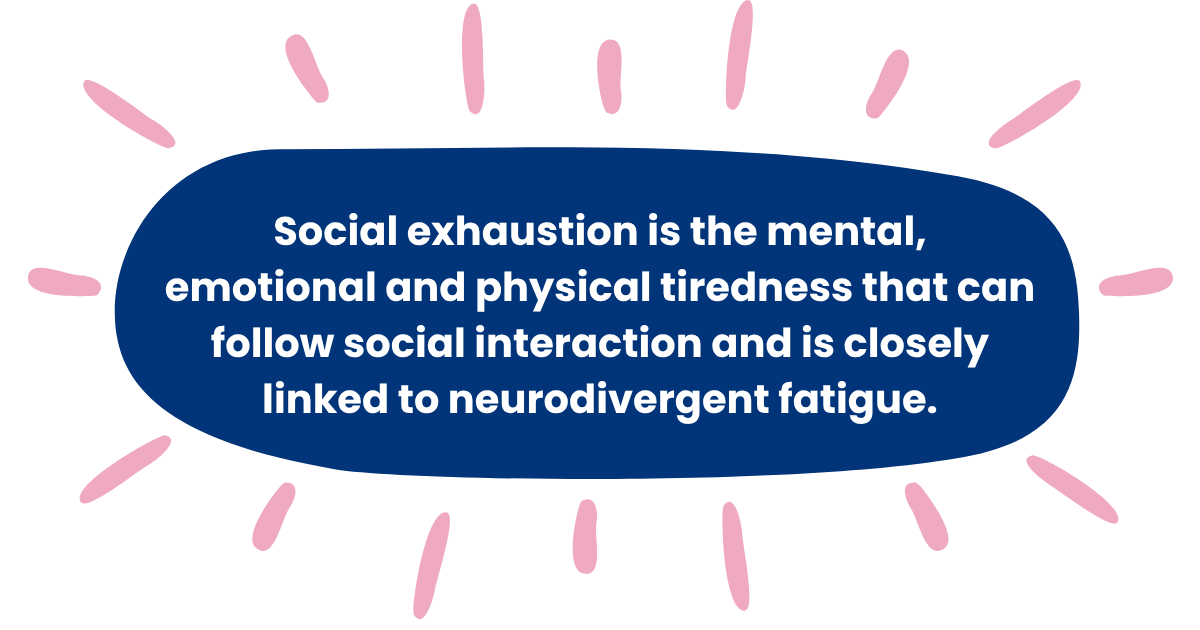
For AuDHD adults, socialising can require intense, often hidden, effort.
Neurodivergent fatigue can result from:
social situations
sensory overload
masking neurodivergent behaviours
suppressing stimulations (also known as stimming or stims)
trying to meet other people’s expectations
If this fatigue builds up over time without enough recovery, it may contribute to burnout. Neurodivergentburnout is described as a long-lasting state of exhaustion, reduced functioning and increased sensitivity to everyday demands.
Why Can Social Interactions Be Exhausting?
Social interaction is rarely just about talking to other people. It can involve many demands at the same time, making social situations more tiring than they may appear.
Masking and Trying to Fit In
Masking is when someone hides or changes their natural behaviour to fit in with other people's expectations.
This can involve:
consciously monitoring conversations
adapting behaviour to meet social expectations
suppressing stimming
rehearsing what to say
For people with ADHD, masking can also involve trying to hide:
distraction
impulsivity
emotional intensity
restlessness
Ongoing masking takes up a lot of mental energy and over time can contribute to fatigue and burnout. People who mask may appear to be coping, but the effort involved is often hidden, particularly for women and girls who may feel greater pressure to fit in with social expectations.
Navigating Hidden Social Rules
Knowing when to speak, how much eye contact to make, how to interpret facial expressions or whether someone is joking may require conscious effort for neurodivergent people.
Constantly thinking about these hidden rules can make social situations mentally demanding.
Feeling Misunderstood
Differences in communication styles can sometimes lead to neurodivergent and neurotypical individuals misunderstanding one another. This is known as the double empathy problem. It suggests that communication difficulties can happen because people experience and interpret the world differently, rather than because one person lacks empathy or social understanding.
A common social challenge occurs when neurodivergent individuals might show empathy by relating another person’s experience to their own. They may be trying to show understanding, but others may see this as changing the subject or making the conversation about themselves. Adults with ADHD have often described themselves as feeling misunderstood when communicating with neurotypical people and report trying harder to fit in.
Repeated misunderstandings can make social situations more tiring. Neurodivergents may use extra energy:
monitoring how they come across
clearing up misunderstandings
masking their natural communication style
Along with masking and trying to meet other people’s expectations, this extra effort may contribute to neurodivergent fatigue and social exhaustion.
Sensory and Cognitive Demands
People may also need to:
cope with background noise
cope with bright lights
follow several conversations at once
remember information
stay focused
manage emotions
For people with AuDHD, several of these demands may prove challenging when happening at the same time. For example, someone may be coping with sensory overload while also trying to focus, follow the conversation and hold back the urge to stim or move.
Dealing with sensory, cognitive and self-regulation demands all at once can make social situations feel exhausting. Holding back natural responses, such as stimming or moving, may also make it harder to feel calm and focused.
Cognitive Demands of Conversation
Conversations can change direction quickly. A person may still be processing one idea when someone interrupts, introduces a new topic or moves the discussion on. These conversational ‘twists and turns’ can make it harder to participate.
Monotropism suggests that autistic people tend to focus deeply on a smaller number of things at one time, which can make it harder to switch quickly between topics.
For people with AuDHD, this may be made harder by ADHD-related communication differences. Adults with ADHD have described finding it difficult to:
hold information in mind
organise their thoughts
stay focused on the topic
manage several thoughts at once
wait for their turn to speak
As a result, conversations may require a great deal of mental effort for neurodivergents. Over time, this may contribute to social exhaustion.
The Emotional Impact of Social Interactions
As well as the effort involved in taking part in social situations, there can also be an intense build-up and emotional aftermath.
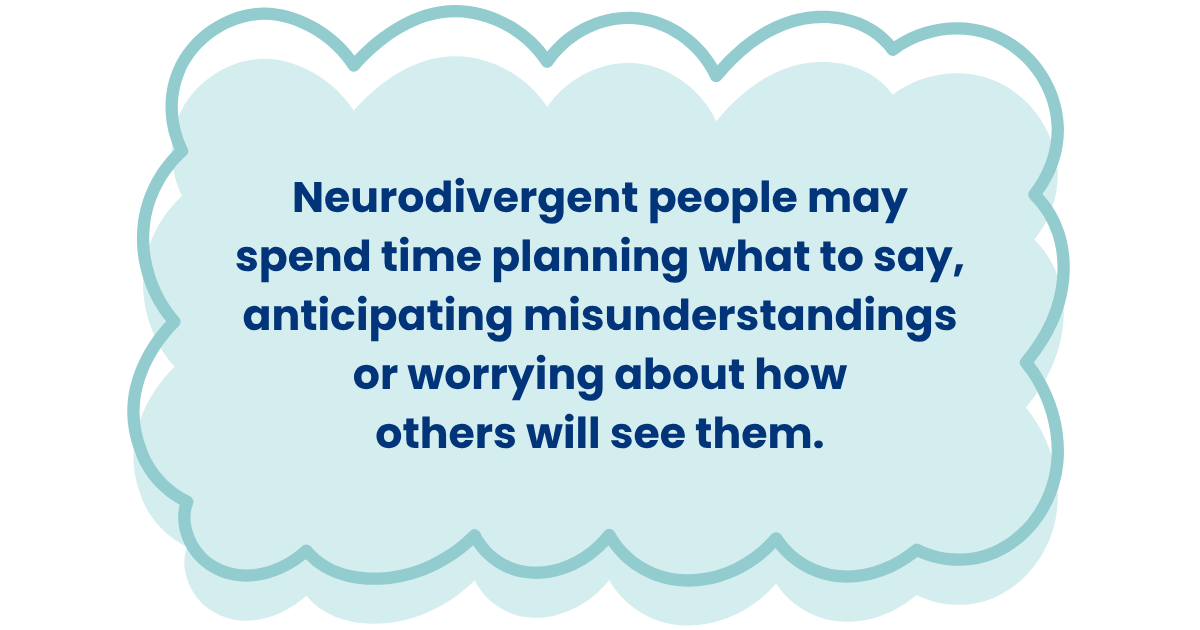
After socialising, neurodivergent individuals may go over many parts of the social situation in their mind more than neurotypical individuals. They may worry about what they said, how others reacted or whether they missed a social cue. They may also need time alone to recover. This is sometimes described as a social hangover.
Emotional dysregulation, common in ADHD, may make difficult social experiences harder to move on from. Worrying about one social situation may then increase anxiety about the next, creating a cycle that adds to social exhaustion over time.
How Autistic and ADHD Traits Can Interact when Socialising
Research into AuDHD is still developing, however, having both autistic and ADHD traits can create experiences that are different from having either one alone.
An AuDHD person may enjoy socialising, novelty, and stimulating conversations, while also finding social situations draining. These different needs can pull in opposite directions.
Social exhaustion may therefore come from the combined effect of autistic and ADHD traits, with different demands building up at the same time. This helps explain why it can involve more than simply feeling tired after socialising.
How Can Social Exhaustion Affect Relationships?
Social exhaustion can leave people with less energy to:
keep in touch
reply to messages
making/keeping social plans
spend time with others
Withdrawing from socialising does not always mean someone is uninterested or uncaring. People may be exhausted, overwhelmed, or simply need time to recover.
Adults with ADHD have described forgetting to contact people, struggling to keep up with messages, overexplaining, and misunderstanding other people’s reactions. They may also worry that they are “too much” for others.
These difficulties can lead to misunderstandings. Someone may seem rude, uncaring, or uninterested when they are actually tired, distracted, or recovering from social effort.
Over time, this can make relationships feel more difficult and increase anxiety about social contact. The problem is often not a lack of care, but the effort needed to stay connected while managing social exhaustion.
What Can Help with Social Exhaustion?
There is no single way to manage social exhaustion. However, it can help to recognise that it is a real response to demanding social situations, rather than a personal failing.
People may find it helpful to:
notice their own limits
plan time to recover after social events
set realistic expectations for themselves
reduce the pressure to mask
spend time with people who accept different ways of communicating and the possible need for temporary social withdrawal
Some neurodivergent adults describe feeling relief when they no longer feel they have to hide neurodiverse traits or meet neurotypical expectations.
Supportive relationships can also make a difference. Adults with ADHD have described feeling more accepted and finding communication easier with other neurodivergent people. Feeling understood and supported may also reduce isolation and social exhaustion.
Conclusion
Social exhaustion is more than feeling tired after socialising. For AuDHD adults, it can come from the effort of masking, managing sensory and communication demands, and recovering afterwards.
Withdrawing or needing time alone does not mean someone does not care. It may mean they are overwhelmed or need time to recover.
Understanding social exhaustion can help people recognise their limits, plan time to rest and build relationships where their needs are accepted.
References
National Autistic Society. Autistic fatigue – a guide for autistic adults. 2020. Available from:https://www.autism.org.uk/advice-and-guidance/mental-health/autistic-fatigue/autistic-adults. Accessed 26 June 2026.
Raymaker DM, Teo AR, Steckler NA, Lentz B, Scharer M, Delos Santos A, et al. “Having all of your internal resources exhausted beyond measure and being left with no clean-up crew”: Defining autistic burnout. Autism in Adulthood. 2020;2(2):132–143. doi:10.1089/aut.2019.0079.
Black MH, Clarke PJF, Deane E, Smith D, Wiltshire G, Yates E, et al. “That impending dread sort of feeling”: Experiences of social interaction from the perspectives of autistic adults. Research in Autism Spectrum Disorders. 2023;101:102090. doi:10.1016/j.rasd.2022.102090.
Ginapp CM, Greenberg NR, Macdonald-Gagnon G, Angarita GA, Bold KW, Potenza MN. The experiences of adults with ADHD in interpersonal relationships and online communities: A qualitative study. SSM – Qualitative Research in Health. 2023;3:100223. doi:10.1016/j.ssmqr.2023.100223.
Craddock E. Being a woman is 100% significant to my experiences of attention deficit hyperactivity disorder and autism: Exploring the gendered implications of an adulthood combined autism and attention deficit hyperactivity disorder diagnosis. Qualitative Health Research. 2024;34(14):1442–1455. doi:10.1177/10497323241253412.
Milton DEM. On the ontological status of autism: The “double empathy problem”. Disability & Society. 2012;27(6):883–887. doi:10.1080/09687599.2012.710008.
Kimber L, Verrier D, Connolly S. Autistic people’s experience of empathy and the autistic empathy deficit narrative. Autism in Adulthood. 2024;6(3):321–330. doi:10.1089/aut.2023.0001.
Garau V, Murray AL, Woods R, Chown N, Hallett S, Murray F, et al. Development and validation of a novel self-report measure of monotropism in autistic and non-autistic people: The Monotropism Questionnaire. Autism. 2023;27(6):1824–1838. doi:10.1177/13623613221141529.
Zhang S, Li S, Li Q. Understood: Real-time communication support for adults with ADHD using mixed reality. In: Proceedings of the 38th Annual ACM Symposium on User Interface Software and Technology (UIST ’25). New York: Association for Computing Machinery; 2025. p. 1–23. doi:10.1145/3746059.3747602.
Shaw P, Stringaris A, Nigg J, Leibenluft E. Emotional dysregulation and attention-deficit/hyperactivity disorder. American Journal of Psychiatry. 2014;171(3):276–293. doi:10.1176/appi.ajp.2013.13070966.
Craddock E. Raising the voices of AuDHD women and girls: Exploring the co-occurring conditions of autism and ADHD. Disability & Society. 2024;39(8):2161–2165. doi:10.1080/09687599.2023.2299342.
Berry BAR. What are the perspectives of late-diagnosed women with Autism Spectrum Condition (ASC) and Attention Deficit Hyperactive Disorder (ADHD), and how do the conflicting symptoms impact their experience of secondary school? Fields: Journal of Huddersfield Student Research. 2025;2(1). Available from:https://www.fieldsjournal.org.uk/article/id/1612/. Accessed 1 August 2026.
Neff MA. 6 ways ADHD hides autism (and what AuDHD really looks like). Neurodivergent Insights. 2026. Available from:https://neurodivergentinsights.com/adhd-hides-autism/. Accessed 1 August 2026.