
Masking Behaviours in Late-Diagnosed AuDHD Adults
Introduction
Masking (also known as camouflaging) neurodivergent behaviours is a common strategy that many neurodivergent individuals use to navigate their daily lives.
This research article will cover:
What is masking?
What is the cost of masking?
How is masking related to late diagnosis of AuDHD?
What advice and support is there for neurodivergents who want to unmask?
What are masking behaviours, and why do people use them?
There are many different ways to refer to these behaviours; however, in general, “masking” is the most common in the neurodiverse community. “Camouflaging,” “compensation,” and “adaptive morphing” can also be used.
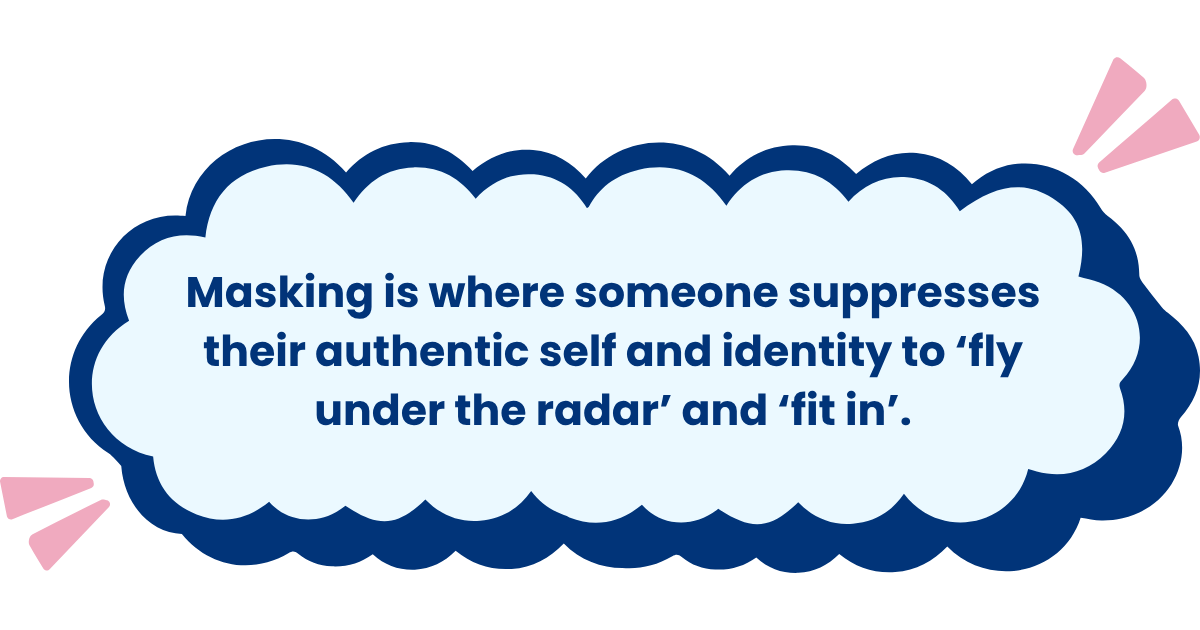
These behaviours can be both conscious and unconscious.
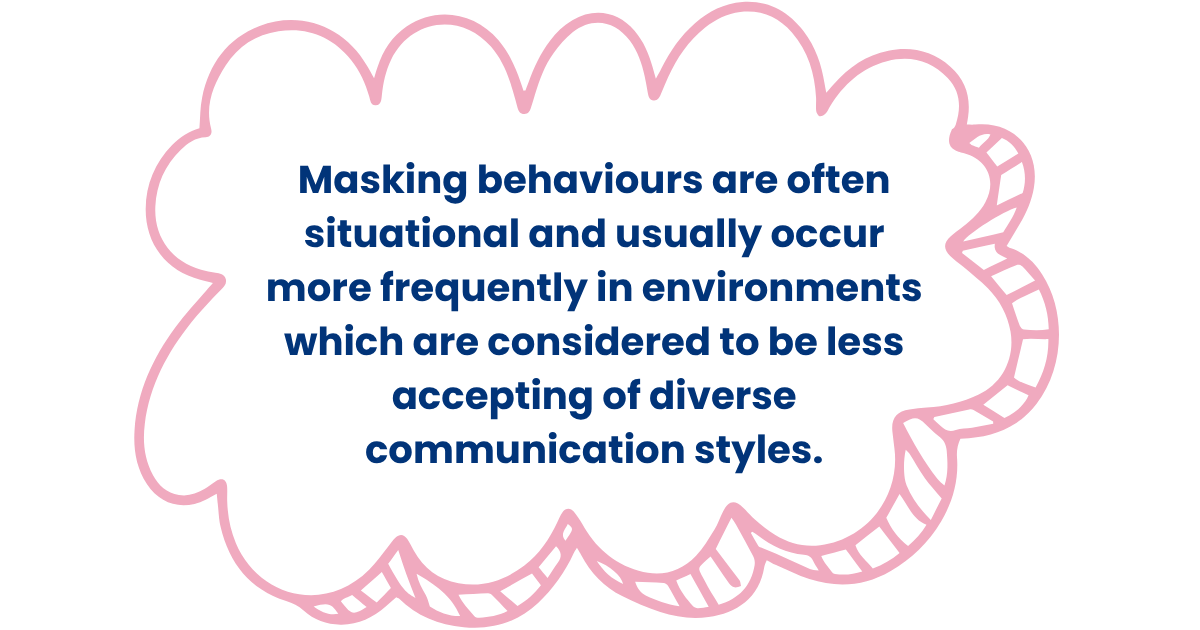
Many neurodivergent individuals feel the need to mask in order to avoid the stigma that can arise from negative stereotypes about neurodivergent socialisation and therefore reduce negative social experiences. Another driver for masking is to try to gain social acceptance.
Studies have shown that masking is not simply restricted to neurodiverse people, but similar behaviours can also be observed amongst neurotypical people. One of the major differences however, is that amongst neurodiverse people, masking tends to be:
More common
More intense
Associated more with specific behaviours such as suppression of stimming
Associated more with suicidal ideation
Although more well-known in the autism community, there is a growing amount of research which suggests that masking is relatively common amongst people with ADHD, with masking behaviours in people with ADHD found to be up to 92%.
Masking behaviours vary from person to person, but some examples may include:
Forcing eye contact and other non-verbal communication
Suppressing stimming (as previously mentioned)
Creating social scripts
Feeling forced to engage in small talk

What are the costs of masking behaviours?
While there are short-term social advantages, masking can be physically and mentally exhausting, leading to more severe costs, such as:
Reduced quality of life
Increased mental health difficulties
Identity disturbance and feeling misunderstood
Reduced closeness and connection with others
Perpetuation of unrealistic expectations
Increased levels of masking are associated with greater levels of anxiety and suicidal ideation. Masking is also thought to be a cause of late or misdiagnosed neurodivergence among women, despite women having equal measures of internal experiences in comparison to their male counterparts.
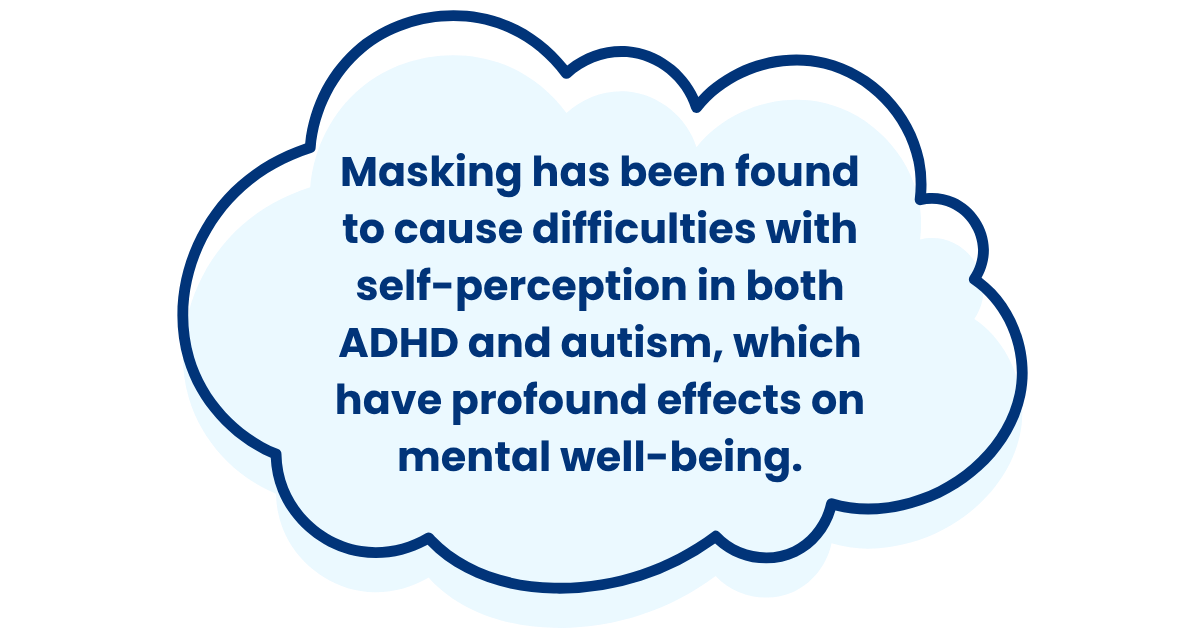
Active suppression of neurodivergent traits is likely to be the most costly of masking behaviours, and forcing the presentation of neurotypical behaviours tends to be associated more with identity disturbance.
Some strategies, such as planning ahead and using tools, can be helpful with minimal negative consequences.
How does masking relate to a late-diagnosis of AuDHD in adults?
Masking contributes to delayed diagnoses and limits a neurodivergent individual’s access to support. This is compounded by the already present challenges of obtaining an AuDHD diagnosis. Masking can be mistaken by others as “apparently coping,” which adds complexity to assessments and can lead care professionals to dismiss symptoms.
A late-diagnosis can be extremely liberating and a great source of relief, as it can help individuals to understand decades of their behaviour and give them the confidence to make the changes they need to for a happier life through rebuilding their identity.
There is also a noticeable pattern of individuals presenting to clinicians when they feel burned out, especially at university and when entering the workforce, where expectations and demands change.
What advice and support exists for individuals looking to unmask?
On a broader scale, the effects of masking can simply be reduced by promoting neurodiverse social inclusion through activism and awareness - and challenging neurotypical norms. This will ultimately boost social acceptance and empower neurodivergent individuals to be themselves.
Increasing the acceptance of neurodiverse behaviours reduces the pressure on people with autism and ADHD to socially perform. Other ways people can help are:
Allow flexible/hybrid working
Allowing more time to recover after social interactions
Promoting awareness amongst education and medical professionals
Encouraging public venues to provide more quiet hours and spaces
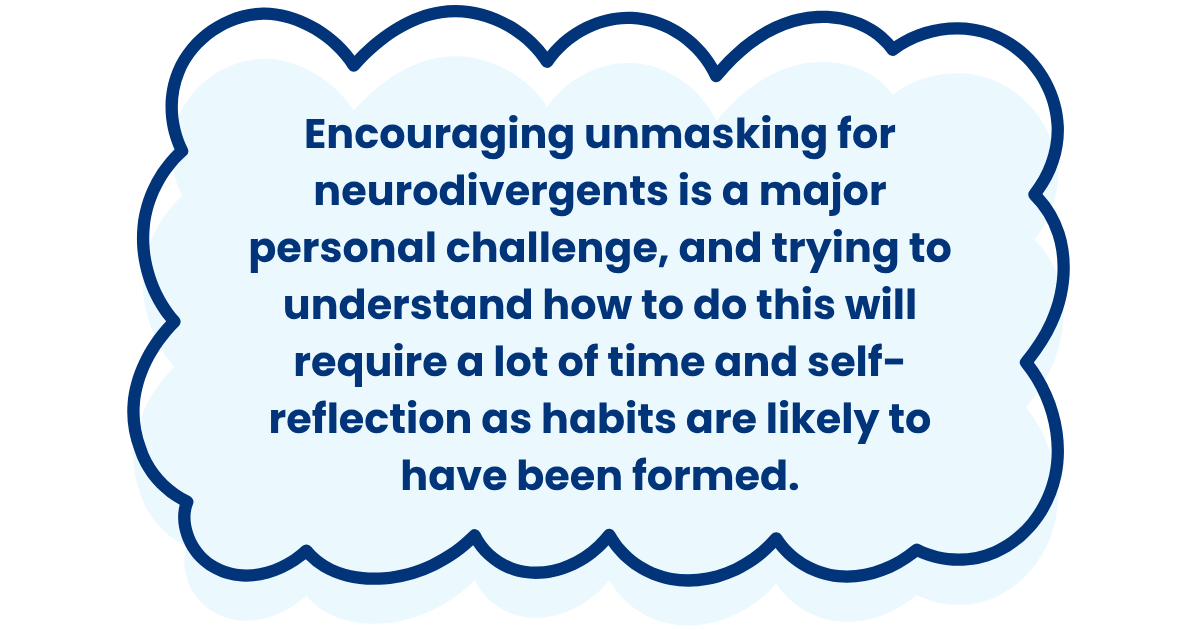
In addition, some people may not always be fully supportive when neurodivergent people attempted unmasking in the past. Many neurodivergents find that there are some situations where masking is simply unavoidable, and that is sometimes necessary for safety.
Top tips for neurodivergent individuals looking to stop masking:
Give yourself time to understand and express your true self
Share your experiences with other neurodivergent people to improve self-understanding
Maintain a gentle pace and test out different social environments to see where you feel comfortable unmasking
Summary
Masking is where people alter their behaviour to increase social-acceptance
Masking is very common in the neurodivergent community
Neurodiverse people often force themselves to use these behaviours, which naturally come with costs including reduced quality of life, identity disturbance, reduced closeness with others and reduced mental health
Anyone can engage in masking behaviours, however they have often been associated more with women
Doing our individual part to create an inclusive social environment will encourage people to unmask and improve mental health outcomes
References
Miller D, Rees J, Pearson A. “Masking Is Life”: Experiences of Masking in Autistic and Nonautistic Adults. Autism Adulthood 2021; 3: 330.
Mylett ML, Boucher TQ, Iarocci G. “I wish I could just be myself”: Experiences of social camouflaging in adults with ADHD. Research in Neurodiversity 2026; 2: 100018.
Wurth P, Fuermaier ABM, Strand AH, et al. Diagnosis acceptance, masking, and perceived benefits and challenges in adults with ADHD and ASD: associations with quality of life. Front Psychiatry 2025; 16: 1668780.
Cage E, Troxell-Whitman Z. Understanding the Reasons, Contexts and Costs of Camouflaging for Autistic Adults. J Autism Dev Disord 2019; 49: 1899.
Stubbs R. Adults with ADHD may pay high price to mask traits and fit in, SFU study finds - SFU News - Simon Fraser University. SFU, https://www.sfu.ca/sfunews/stories/2026/06/adults-with-adhd-may-pay-high-price-to-mask-traits-and-fit-in--s/ (2026, accessed 11 June 2026).
O’Reilly D. The Late-Diagnosed Mind: ADHD and Autism in Adults | Psychology Today United Kingdom. Psychology Today, https://www.psychologytoday.com/gb/blog/the-late-diagnosed-mind/202603/the-late-diagnosed-mind-adhd-and-autism-in-adults (2022, accessed 17 June 2026)
Masking. National Autistic Society, https://www.autism.org.uk/advice-and-guidance/behaviour/masking#The%20impact%20of%20masking (2026, accessed 17 June 2026).
Masking when you’re autistic | Autism Space | Leicestershire Partnership NHS Trust. NHS, https://www.leicspart.nhs.uk/autism-space/health-and-lifestyle/autistic-masking/ (2023, accessed 17 June 2026).